By Maverick
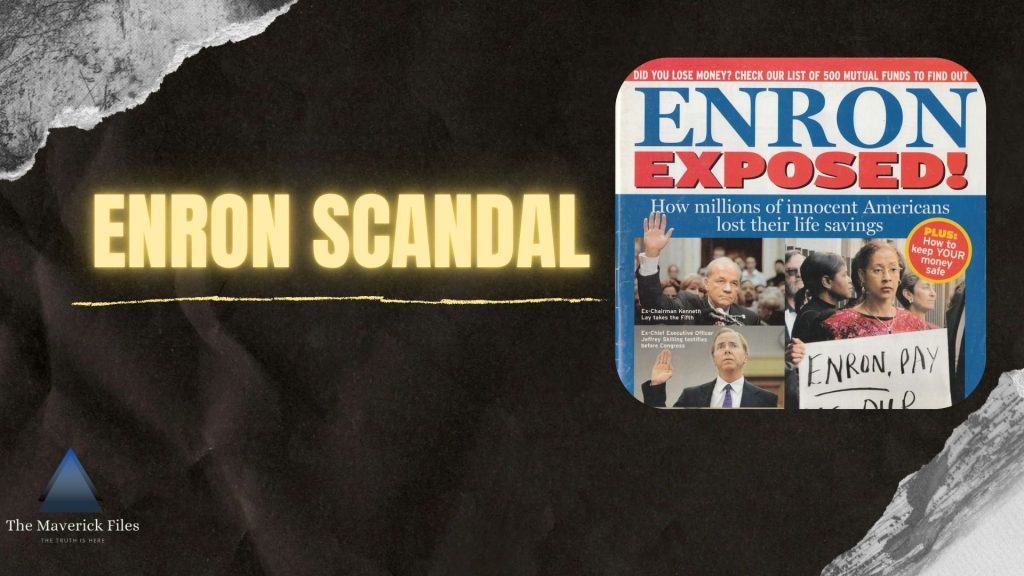
The Enron scandal, one of the most infamous corporate fraud cases in history, which altered the corporate landscape and shook the financial world to its core in the early 2000s. It involved widespread accounting fraud, corporate malfeasance, and ultimately led to the bankruptcy of Enron Corporation, an American energy giant. The scandal had prevalent consequences, prompting regulatory changes and reshaping corporate governance practices.
Enron was founded in Houston, Texas, in 1985 by Kenneth Lay and Jeffrey Skilling, functioning primarily as a natural gas and electricity company. Enron pioneered energy trading, allowing it to dominate the energy market by buying and selling future contracts. At its height, it was the 7th largest company in the U.S. and held operations in more than 40 countries.
Throughout the 1990s, Enron reported massive growth, with stock prices soaring and executives earning huge bonuses. Enron diversified into various markets, including broadband and even water. It was celebrated as a shining example of innovation, risk-taking, and leadership in the modern economy. However, this was largely based on illusion, with the company’s true financial state hidden through accounting gimmicks.
Enron used Special Purpose Entities (SPEs) to hide debt and inflate earnings. These entities allowed Enron to keep significant liabilities off its balance sheet, artificially boosting profits and keeping its stock price high. The founder and two CEOs of Enron, Kenneth Lay and Jeffrey Skilling, were complicit in this series of fraudulent acts, as well as the CFO of Enron, Andrew Fastow.
Enron used this method to report expected future profits as current income. This allowed the company to claim unrealized earnings, which created a distorted image of profitability when they should’ve been recording liabilities. SPEs were specifically these complex financial structures that Enron used to shift debt and keep it off the books. Essentially, these entities borrowed money to fund Enron’s operations, while Enron reported profits without including the associated debt on its balance sheet.
Enron’s auditor, Arthur Andersen, a top notch accounting firm (part of the Big-Five), was also complicit in the fraud, signing off on Enron’s financial statements and shredding incriminating documents when the investigation began. By mid-2001, cracks in Enron’s facade began to show, revealing the true nature of these malevolent players. It all came down like a house of cards as the company’s finances couldn’t sustain its heavy debt load, and questions about its accounting practices began to arise. In October 2001, Enron was forced to admit it had overstated its earnings by nearly $600 million. Enron then announced it would restate all earnings due to “accounting errors.” That’s when the Security and Exchange Commission or SEC, launched an official investigation in November 2001. revealing the depth of Enron’s accounting irregularities. By December 2001, Enron filed for bankruptcy, marking it to be one of the largest corporate bankruptcies in U.S. history.
As a result of shit hitting the fan, shareholders invested in the company lost about $74 billion with a B, between 2000 and 2002. All Enron employees lost their jobs, benefits, and investments tied to Enron stock, which became worthless. Enron’s founder and CEO, Kenneth Lay, was convicted of fraud and conspiracy but passed away before sentencing, how convenient. The other CEO, Jeffrey Skilling, was convicted and sentenced to 24 years in prison, later reduced to 14 years due to a Supreme Court ruling. Enron’s CFO, Andrew Fastow, pleaded guilty to fraud and served a reduced sentence for cooperating with the investigation. Enron’s auditor Arthur Andersen, one of the “Big Five” accounting firms, was dissolved after being found guilty of obstruction of justice.
In response to the Enron scandal, the U.S. Congress passed the Sarbanes-Oxley Act in 2002, which introduced stricter regulations on corporate governance and accounting practices. Some of its key provisions include:
– Holding CEOs and CFOs personally accountable for the accuracy of financial statements.
– Banning companies from using the same firm for auditing and consulting services.
– Strengthening protections for whistleblowers.
Many vital lessons have been learned as a result of the Enron Scandal, such as corporate transparency. Enron’s downfall highlighted the dangers of opaque financial practices, so now companies are expected to disclose more about their operations and financial health to investors. The Enron scandal underscored the need for independent, objective auditing to prevent corporate fraud. The downfall of Arthur Andersen also warned other auditors about the consequences of compromising ethics.
Enron’s whistleblower, Sherron Watkins, played a pivotal role in exposing the fraud within the company. The scandal led to a greater emphasis on protecting whistleblowers, encouraging them to report unethical practices even if they are in fear of something bad happening to them, at least professionally speaking. What happened to Enron serves as a reminder for investors to be cautious and do their due diligence when relying solely on stock prices or company reports, which can easily be manipulated and doctored to appear as if everything is copacetic, as displayed by the heads of Enron with their unchecked greed and corporate malfeasance.
There was even one conspiracy theory that hadn’t been discussed widely enough although not proven, that suggested a majority of the financial records linked to the Enron scandal were housed in the Securities and Exchange Commission’s branch at the former 7 World Trade Center, which was destroyed when it came down officially due to fire, into its own footprint on September, 11th, 2001, the same day the Twin Towers were destroyed. 7 WTC was a separate building across the street from where the Towers used to stand. Conspiracy theorists have suggested that this building was taken down in a controlled demolition due to the video and physical evidence that has the earmarks of something elaborately planned by a sinister and sophisticated group of conspirators, not by fire, Al-Qaeda, or any Islamic Jihad terrorist group. Please share your thoughts in the comment section. Be well.