By Maverick
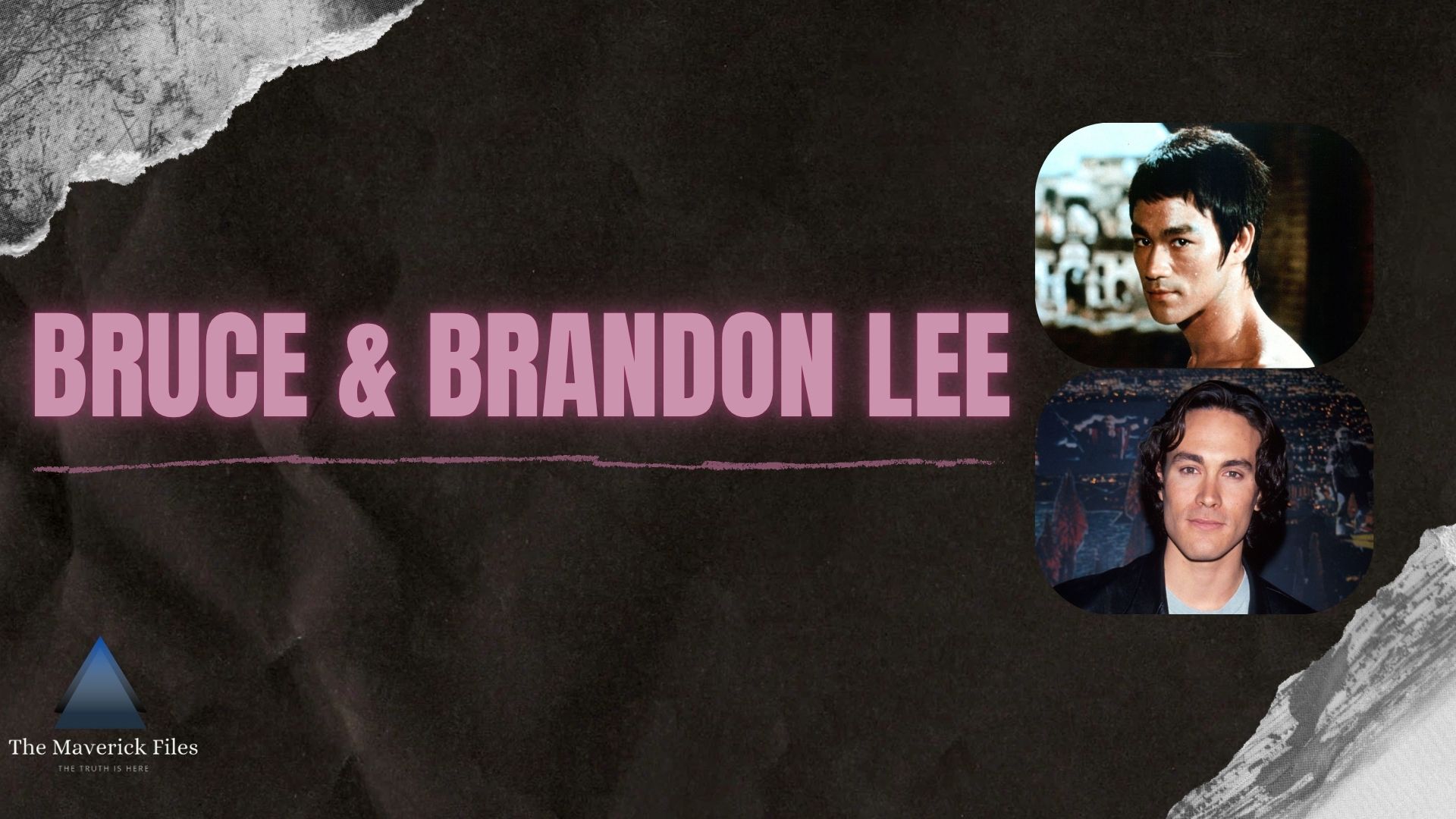
Bruce Lee and his son Brandon Lee occupy a rare and haunting place in pop culture, a father and son, both young rising stars, both dead under sudden and controversial circumstances, and both surrounded by decades of conspiracy theories that continue to blur the line between tragedy and myth.
Bruce Lee’s rise to fame was nothing short of revolutionary. Born Lee Jun-fan on November 27th, 1940, in San Francisco, California, and raised in Hong Kong, he began as a child actor before dedicating himself to martial arts. After returning to the United States, he opened martial arts schools and developed his own philosophy, Jeet Kune Do, emphasizing adaptability and efficiency. Hollywood initially struggled to cast him in leading roles due to racial barriers, but he broke through with television appearances and later with films that would redefine action cinema. Movies like The Big Boss, Fist of Fury, and Enter the Dragon turned him into an international icon. Known for his lightning-fast strikes, philosophical mindset, and magnetic screen presence, Bruce Lee became a symbol of strength, discipline, and cultural pride.
On July 20th, 1973, at the height of his fame, Bruce Lee died suddenly in Hong Kong at the age of 32. The official cause of death was cerebral edema, swelling of the brain, believed to be a reaction to a painkiller he had taken containing meprobamate and aspirin. The ruling was “death by misadventure,” indicating an accidental reaction rather than intentional harm. However, the simplicity of this explanation has never fully satisfied the public, especially given Lee’s peak physical condition and seemingly unstoppable trajectory.
As per usual, conspiracy theories began to emerge. One of the earliest and most persistent claims was that Bruce Lee had been murdered by Chinese triads or organized crime groups. According to this theory, Lee had angered powerful figures in the Hong Kong film industry or criminal underworld, possibly by refusing to cooperate or by disrupting existing power structures. Others suggested he was targeted for teaching martial arts to Westerners, something that was controversial in certain traditional circles at the time. Despite these claims, no concrete evidence has ever linked his death to organized crime.
Another widely discussed theory revolves around the idea of a “family curse.” Some believe that Bruce Lee’s death, and later his son’s, was the result of a supernatural or generational curse. This belief is often tied to Chinese folklore and the notion that spiritual imbalances or ancestral forces can bring misfortune. While there is no factual basis for such claims, the narrative gained traction after the eerily similar fate of his son two decades later.
There are also medical alternative theories. Some researchers have suggested that Bruce Lee may have suffered from heatstroke, epilepsy, or an undiagnosed hypersensitivity to certain substances. More recent analyses have proposed that excessive water intake may have contributed to a condition called hyponatremia. These theories attempt to provide a more nuanced medical explanation but remain speculative.
Two decades later in 1993, tragedy struck again with Brandon Lee. Brandon Bruce Lee, born on February 1st, 1965, in Oakland, California, became an actor and martial artist just like his father, who successfully forged his own path in Hollywood as a rising action star, while navigating the immense legacy of Bruce Lee. After studying acting in New York and appearing in early projects like Legacy of Rage (1986) and Showdown in Little Tokyo (1991), he gained attention for his charisma and physical precision in the 1992 film Rapid Fire. He landed his breakout role in The Crow, a dark, gothic revenge story that would ultimately become inseparable from his fate.
On March 31st, 1993, during the filming of The Crow in North Carolina, Brandon Lee was fatally wounded on set. The official account states that a prop gun used in a scene was improperly prepared. A dummy round had previously left a bullet lodged in the barrel, and when a blank cartridge was fired during filming, inadvertently by actor Michael Massee, it propelled the lodged projectile out of the gun with lethal force. Lee was struck in the abdomen and died later from his injuries. His death was ruled an accident caused by negligence in prop handling, and no criminal charges were ultimately pursued.
Despite the detailed explanation, conspiracy theories quickly surrounded Brandon Lee’s death as well. One of the most prominent is the continuation of the “Lee family curse” narrative. The fact that both father and son died young, under unusual circumstances, and at the peak of their careers, led many to believe there was something more than coincidence at play. This idea became deeply embedded in pop culture, often cited as one of Hollywood’s most eerie generational tragedies.
Another theory suggests sabotage or intentional wrongdoing on the set of The Crow. Some have speculated that the prop gun incident was not an accident but a deliberate act. These theories often point to alleged inconsistencies in how the prop was handled or how safety protocols failed. However, multiple investigations concluded that the death resulted from a series of human errors rather than a coordinated plot.
A more symbolic and widely discussed aspect of the conspiracy culture is the so-called “curse of The Crow.” The film itself deals with themes of death, resurrection, and vengeance, and the tragic loss of its lead actor during production added a layer of real-life darkness to its mythology. Some fans believe the film was “cursed,” pointing not only to Brandon Lee’s death but also to various reported accidents and mishaps during filming. While film productions often encounter logistical challenges, the narrative of a curse persists because of the film’s tone and the tragedy associated with it. The Crow was eventually completed and released the following year in 1994. Brandon was even rumored to have been a top choice as the lead character Neo in the 1999 film The Matrix, but Keanu Reeves ended up playing the character, which really pushed him into stardom as an actor. I sometimes wonder how The Matrix franchise would’ve been if Brandon Lee had lived and played the role.
There are also broader theories that connect both Bruce and Brandon Lee’s deaths to industry pressures or hidden forces within Hollywood, like the secret society group of elites, the Illuminati. These ideas suggest that their rising influence, particularly as Asian and Asian-American leading men in a predominantly Western industry, may have made them targets. However, these claims remain speculative and unsupported by tangible evidence.
What continues to fuel these conspiracy theories is the combination of timing, symbolism, and legacy. Both men died at 32 and 28, respectively, at pivotal moments in their careers. Both deaths involved circumstances that, while explained, feel unusual or improbable to many observers. And both left behind legacies that only grew larger after their passing.
In reality, the official accounts remain grounded in tragic accidents, Bruce Lee’s death attributed to a fatal reaction leading to brain swelling, and Brandon Lee’s to a catastrophic failure in on-set safety procedures. Yet the human tendency to search for deeper meaning, especially when confronted with such striking parallels, ensures that alternative explanations endure. Like always, though, everything is brushed off as serendipitous, but I don’t think so. You also had the deaths of Tejano superstar, Selena Quintanilla-Perez, and rapper Nipsey Hussle also happen on March 31st of 1995 and 2019, also from gunshot wounds.
All conspiracy theories aside, the legacies of Bruce and Brandon Lee transcend the mysteries surrounding their deaths. Bruce Lee transformed martial arts cinema and challenged cultural barriers, while Brandon Lee showed immense promise as an actor poised to define his own path. Their stories, intertwined by both blood and tragedy, continue to captivate audiences, not just for the questions they leave behind, but for the brilliance they displayed in the time they had. Please share your thoughts in the comment section. Be well.