By Maverick
In August 1964, the United States claimed that North Vietnamese patrol boats launched unprovoked attacks on U.S. Navy destroyers in the Gulf of Tonkin, which was a stretch of water off the coast of Vietnam. These alleged assaults provided then-President Lyndon B. Johnson with the justification he needed to escalate U.S. involvement in Vietnam. This led to the Gulf of Tonkin Resolution, passed almost unanimously by Congress, which gave President Johnson virtually unlimited power to wage war in Southeast Asia without a formal declaration.
However, over time, documents, testimony, and declassified intelligence have painted a very different picture, one suggesting the Gulf of Tonkin incident was not what Americans were told or that one of the unprovoked attacks never happened. Many skeptics now consider it one of the most infamous false flag operations in modern history. Let’s break down the official story and what we’ve been told over the years.
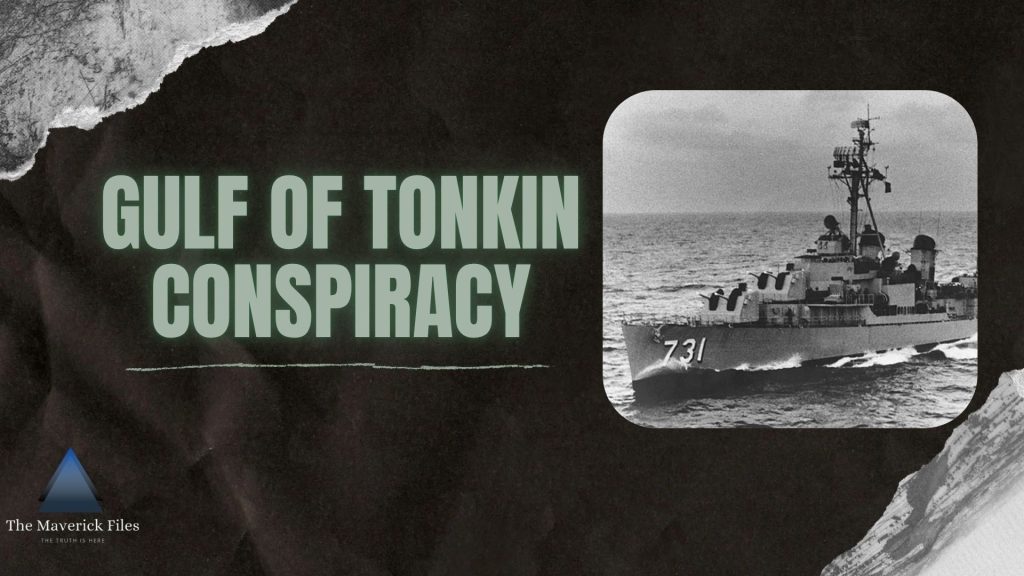
According to the Johnson administration and U.S. military reports at the time, on August 2nd, 1964, the USS Maddox was allegedly attacked by three North Vietnamese torpedo boats in the Gulf of Tonkin. That was the first attack. Two days later, on August 4th, the Maddox and another destroyer, the USS Turner Joy, supposedly came under a second, more intense attack. The U.S. Navy claimed both ships successfully defended themselves, sinking enemy vessels and avoiding serious damage. President Johnson quickly went on national television, describing “unprovoked aggression” and calling for decisive action to protect American interests. Within days, Congress passed the Gulf of Tonkin Resolution, effectively giving Johnson “carte blanche” or the freedom to do what he wished, to escalate U.S. military action in Vietnam.
Even at the time, some in the military and intelligence community had doubts. The radar and sonar readings from August 4th, 1964, were inconsistent, confusing, and likely misinterpreted. Bad weather, overexcited radar operators, and even phantom blips may have created the illusion of an attack.
Decades later, declassified National Security Agency (NSA) documents confirmed what many suspected: that the supposed second attack never happened. The USS Maddox had actually provoked the first skirmish with the North Vietnamese boats by conducting electronic surveillance and assisting South Vietnamese commando raids against North Vietnam. It’s no wonder they attacked because the U.S. provoked them and even blamed a second attack on them. President Johnson and Secretary of Defense Robert McNamara knew the second attack was “unconfirmed”, yet they used it to justify full-scale war.
Throughout my previous blogs, I’ve mentioned the term false flag operation. To review, it refers to a government’s deliberate deception to justify political or military action. The deception being is that if a pretext happens like an unprovoked attack against a country or nation, and it’s revealed that it was due to another country but in reality it was actually conducted by the country that was attacked. The Gulf of Tonkin fits that pattern almost perfectly.
You have the provocation where the U.S. intentionally placed warships near North Vietnam during covert raids, baiting a potential response. You have the fabrication, which is when reports of a second attack came in (based on faulty radar readings), the Johnson administration treated it as fact, despite the unequivocal doubts. Then comes manipulation, where President Johnson told the American public, “Repeated acts of violence against the armed forces of the United States must be met, not only with alert defense, but with positive reply.” This mother fucker was clearly hell-bent on waging a war with North Vietnam. Lastly comes the legislation change, where U. S. Congress, stirred by patriotic anger and fear, passed the Gulf of Tonkin Resolution almost unanimously. Soon after, U.S. ground troops flooded Vietnam, and full-scale war began, leading to more than 58,000 American deaths and millions of Vietnamese casualties.
The draft for the Vietnam War was implemented shortly thereafter to meet the U.S. military’s quota for personnel to fight in the war, which was escalating rapidly after 1965. Men between the ages of 18-26 were drafted to fight in the war. My father was one of them. It was like a lottery system where those who could potentially be drafted were assigned a number to each birth date, with lower numbers being called to service first. The public initially supported the war, but as more men were drafted and the war continued, public opposition grew. The duration of the war was also frustrating to many lower and working-class individuals because of the impact it was having. It was beyond fucked up that men were forced to join the battle and had no choice but to oblige. Draft evasion was common with men, too, attempting to use every deferment in the book to evade being sent off to war to potentially get severely injured or be killed.
Conspiracy theorists argue that President Johnson deliberately exaggerated or fabricated the Gulf of Tonkin incident as a pretext to gain political capital and push an agenda for military escalation. His approval ratings soared after his speech, and the resolution gave him immense power without the need for congressional debate. Declassified NSA documents suggest selective reporting, that analysts withheld contradictory intelligence that questioned the second attack. The CIA and NSA had overlapping operations in the area, many still classified, leading to theories that intelligence manipulation played a direct role in justifying war. Go figure, as it always seems to come back to the CIA eventually.
During former President Eisenhower’s famous military-industrial complex warning that was delivered in his 1961 farewell address, he used the term to describe it as being the conjunction of an immense military establishment and a large arms industry, cautioning that this alliance could gain unwarranted influence over the government. He urged citizens to be vigilant to ensure that national security didn’t undermine democratic processes, economic stability, or liberty. Eisenhower also warned that the potential for “the disastrous rise of misplaced power” from the military-industrial complex exists and will persist.” This was primarily to expand power and arms sales.
He saw this complex as a new and powerful force in American experience, shaped by the need for a strong military during the Cold War and the rapid growth of the defense industry. He stated that “only an alert and knowledgeable citizenry” could ensure the “proper meshing” of the industrial and military machinery with democratic goals. Beyond the military-industrial complex, Eisenhower also warned about the potential for the domination of public policy by a “scientific-technological elite” and the dangers of massive spending. President Eisenhower’s warning about the “military-industrial complex,” many believe the incident was used to feed war profiteering, boosting defense contractors like Bell Helicopter, Dow Chemical, and Lockheed Martin. Vietnam was not just ideological; it was economic, like every other war we’ve been involved in. The war generated billions for the defense industry. It’s all a business.
Years later, key figures admitted the truth, like Robert McNamara, Secretary of Defense at the time, publicly stated before his death that the August 4th attack “never happened.” Then there was Captain John J. Herrick, commander of the Maddox, who later said that “no actual visual sightings” were made, and the so-called torpedoes were likely phantom radar signals. Can you fucking believe that? All of the shit that this government has got away with and continues to get away with. NSA historian Robert Hanyok, in a 2005 report, concluded that the agency “distorted intelligence” to make it appear as though an attack had occurred. Christ, even President Johnson himself, caught on a recorded phone call, remarked privately that “For all I know, our Navy was shooting at whales out there.” Johnson was a war criminal through and through.
The Gulf of Tonkin Incident stands today as a sobering reminder of how governments can manipulate perception to justify conflict. Whether one calls it a false flag or a colossal blunder, the results were the same: a catastrophic war built on lies and deception. The incident also raises a haunting question. If a single fabricated event could drag the world’s most powerful nation into a decade-long war, how many times has history repeated that same script? Makes you wonder, doesn’t it? I’ve covered other potential false flags before, especially regarding one of the deadliest acts of violence ever carried out, the 9/11 attacks. The Gulf of Tonkin is often compared to other events alleged to be false flags or manipulative pretexts for war, such as the 1990 Kuwaiti incubator story (used to justify the Gulf War), the 2003 Iraq WMD narrative. So to many, the Gulf of Tonkin wasn’t an isolated event or mistake; it was part of a recurring government playbook. Please share your thoughts in the comment section. Be well.