By Maverick
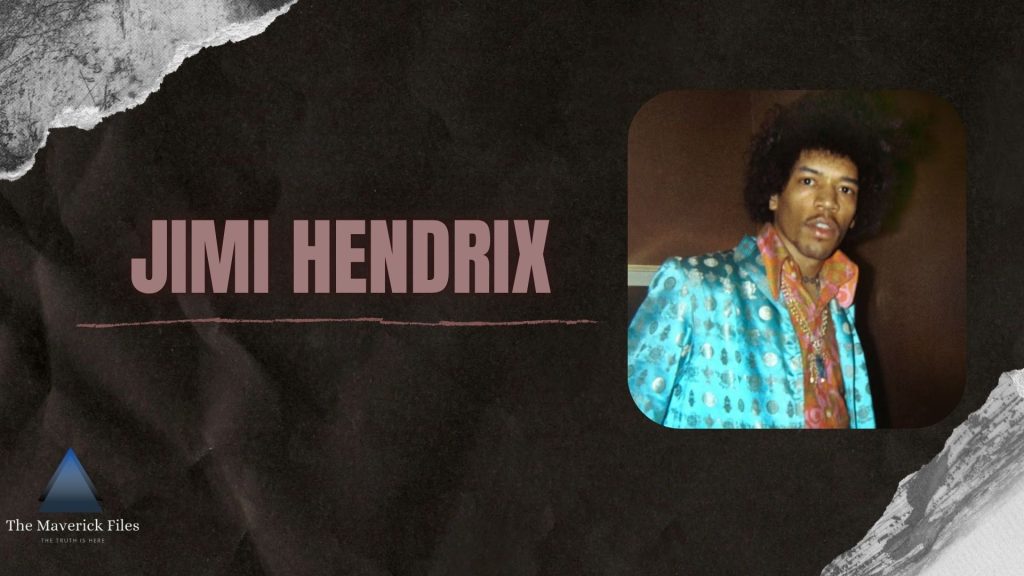
Jimi Hendrix stands as one of the most revolutionary figures in the history of music, a guitarist whose sound, style, and stage presence fundamentally reshaped rock. Born Johnny Allen Hendrix in Seattle, Washington, on November 27th, 1942, he grew up in a turbulent household marked by poverty and instability. Despite these challenges, he found solace in music, teaching himself guitar and developing a style that would later seem almost otherworldly. After a stint in the U.S. Army, Hendrix worked as a backing guitarist for artists like Little Richard and the Isley Brothers, honing his craft on the road. His big break came when he moved to London in 1966 and formed the Jimi Hendrix Experience, quickly gaining attention for his explosive performances and experimental sound.
Hendrix’s rise to fame was meteoric. Albums like Are You Experienced, Axis: Bold as Love, and Electric Ladyland redefined what the electric guitar could do. His use of distortion, feedback, wah-wah pedals, and studio effects created a sonic landscape that was decades ahead of its time. Songs like “Purple Haze,” “Foxy Lady,” and his iconic rendition of “The Star-Spangled Banner” at Woodstock in 1969 cemented his legend. He was known not only for his technical brilliance but also for his theatrical stage presence, playing guitar behind his back, with his teeth, and even setting it on fire. Hendrix became a symbol of the late 1960s counterculture, comprised of innovative, boundary-pushing, and deeply tied to the era’s social and political upheaval.
On September 18th, 1970, Hendrix was found dead in a London apartment at age 27. The official account states that he died after consuming a combination of alcohol and sleeping pills, specifically barbiturates. According to reports, he had taken several Vesparax tablets, a powerful sedative, and later vomited in his sleep, leading to asphyxiation. The coroner ruled his death as “death by misadventure,” meaning it was accidental rather than intentional. There was no official finding of suicide or foul play, and toxicology reports supported the conclusion that a lethal combination of substances led to respiratory failure.
Despite this official explanation, Hendrix’s death has remained one of the most debated and conspiracy-laden cases in music history. One of the most persistent theories is that he was murdered, possibly by someone within his inner circle. Suspicion has often focused on his then-girlfriend, Monika Dannemann, who was with him the night he died. Critics have pointed to inconsistencies in her statements over the years regarding the timeline of events, when emergency services were called, and the exact circumstances in which Hendrix was found. Some noticed that her account changed in ways that raise questions about what truly happened in those final hours. However, no definitive evidence has ever proven her involvement in any wrongdoing. Go figure.
Another major theory centers on Hendrix’s manager, Michael Jeffery. Some conspiracy theorists claim that Jeffery may have had a financial motive to orchestrate Hendrix’s death, allegedly due to a life insurance policy that would pay out more if Hendrix died than if he continued his career under strained management contracts. It always seems to boil down to someone famous being worth more after they pass away prematurely. This theory gained traction decades later when a former associate claimed Jeffery had confessed involvement. However, these claims remain unverified and are often criticized for relying on hearsay rather than concrete evidence. Jeffery himself died in a plane crash in 1973, which only added another layer of mystery for conspiracy-minded observers.
There are also theories suggesting that Hendrix was targeted by government agencies. Because he was a prominent Black artist associated with the counterculture movement and had connections to anti-war circles, some have speculated that he may have been viewed as a political threat, just like Malcolm X and MLK seemed to be. These theories often place his death within the broader context of alleged surveillance and disruption of influential figures during the 1960s. However, no credible documentation has surfaced linking Hendrix to any targeted operation by intelligence agencies.
A different line of speculation questions whether Hendrix’s death was truly accidental or if it may have been a form of suicide. Supporters of this theory point to his reported exhaustion, pressures from fame, disputes with management, and desire to change musical direction. Others counter that he had upcoming projects planned, including new recordings and business ventures, suggesting he was looking toward the future rather than planning an end. The coroner’s ruling of misadventure reflects the ambiguity, acknowledging risk-taking behavior without confirming intent. We’ve heard this with several of the other celebrity death cases we’ve explored, that despite the intent to continue with one’s life and career, it doesn’t mean that someone with copious amounts of struggles isn’t contemplating suicide.
Controversy has also surrounded the medical response and investigation. Some critics argue that the emergency services response was mishandled or that critical details were overlooked. Reports indicated that Hendrix had consumed a large quantity of sleeping pills, but some have questioned whether the amount found in his system matched the number of pills allegedly taken. Others have suggested that he may have been alive longer than initially reported and that delays in treatment could have contributed to his death. While these concerns have been raised repeatedly, no official reinvestigation has overturned the original findings. Besides, it’s been over 50 years since his death, so we can’t be surprised that nothing new has turned up. I mean, every now and then, you hear the media raise additional questions pertaining to Marilyn Monroe’s death, which was over 60 years ago, so maybe it’s never too late.
As with many artists who died at 27, Hendrix is often included in discussions of the so-called “27 Club,” alongside figures like Janis Joplin, Jim Morrison, Kurt Cobain, and Amy Winehouse. Some conspiracy theorists frame this as evidence of a pattern or even a coordinated phenomenon, possibly linked to the powers that be in the Illuminati that “don’t exist.” In reality, most historians and statisticians view it as a coincidence (our favorite word) amplified by cultural fascination with early deaths of influential artists.
Part of what fuels the enduring mystery around Hendrix’s death is the contrast between his extraordinary talent and the suddenness of his end, just like with every other high-profile celebrity demise. He was at a creative crossroads, experimenting with new sounds and potentially moving beyond the confines of the Jimi Hendrix Experience. For fans and observers, it can feel difficult to reconcile such a powerful artistic trajectory with a death attributed to an accidental overdose, but where there is smoke, there is fire, and that’s why I always encourage my readers to follow it no matter what, even if it turns out to be a big notihkg burger in the end. It’s better to know for sure than to leave it unresolved. Ultimately, it all depends on the person and what they are capable of handling. Please share your thoughts in the comment section. Be well.