By Maverick
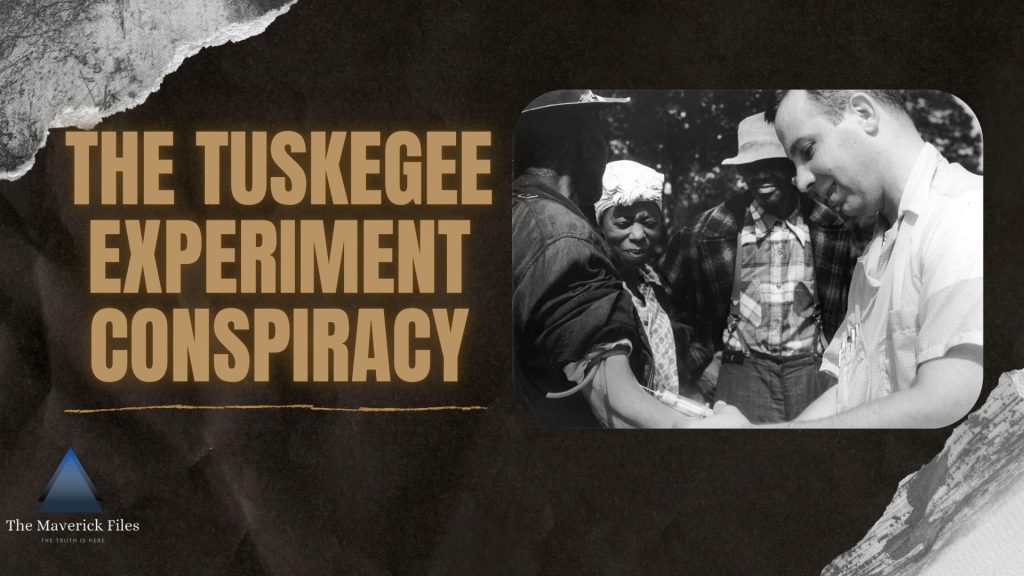
The Tuskegee Syphilis Study from 1932-1972 stands as one of the most disturbing and controversial episodes in American medical history, a case where official narratives and deeper suspicions intersect in ways that still fuel distrust today. Beginning in 1932 in Macon County, Alabama, the study was conducted by the United States Public Health Service in collaboration with the Tuskegee Institute. Its stated purpose was to observe the natural progression of untreated syphilis in Black men. Around 600 African American men, many of them poor sharecroppers, were enrolled, with about 399 already infected and the rest, 201, serving as controls. The study offered free medical exams, meals, and burial insurance to ensure compliance. Sounds too good to be true, right? Well, it was. Crucially, the participants were never given informed consent; they were told they were receiving treatment for “bad blood,” a vague term used locally to describe various ailments, when in reality they were being observed rather than properly treated.
As the study progressed, it became increasingly unethical, particularly after penicillin was widely recognized in the 1940s as an effective cure for syphilis. Instead of administering the cure, researchers deliberately withheld treatment in order to continue documenting the disease’s effects. Participants were misled, denied access to medical care, and in some cases even prevented from receiving treatment elsewhere. Over the decades, many of the men suffered severe health consequences, including blindness, mental deterioration, and death, while their families were also affected through transmission. It was beyond barbaric and inhumane. The study continued for 40 years, ending only in 1972 after a whistleblower named Jean Heller of the Associated Press exposed it, triggering national outrage and leading to congressional hearings. Thank goodness for whistleblowers; this would still be going on unchecked.
Officially, the Tuskegee study is acknowledged as a gross violation of medical ethics, driven by racism, paternalism, and a lack of oversight. It led to major reforms in research ethics, including the establishment of institutional review boards and stricter informed consent requirements. However, beyond the documented facts, the study has also become a focal point for broader conspiracy theories about medical exploitation and systemic abuse. Some theorists argue that Tuskegee was not an isolated incident, but part of a larger pattern of experimentation on vulnerable populations, particularly African Americans, without their knowledge or consent. That makes a whole lot of sense because, as the saying goes, “where there’s smoke, there’s fire, and it’s highly evident that not all the fires have been extinguished. The Tuskegee boondoggle failed because it was exposed, so imagine how many other secret experiments akin to this have been occurring where human beings become guinea pigs.
These suspicions have extended into modern times, with some claiming that the legacy of Tuskegee reflects ongoing covert practices within government or pharmaceutical institutions. While there is no verified evidence supporting large-scale secret experimentation programs today, the historical reality of Tuskegee has made such theories more believable to many. The idea that a government agency knowingly allowed hundreds of men to suffer and die in the name of research has created a lasting skepticism toward public health initiatives, especially in marginalized communities, and for good reason.
There are also misconceptions that have taken on a conspiratorial tone, such as the belief that researchers intentionally infected participants with syphilis. Is it really that far-fetched to believe, considering they withheld the treatment just to study and record the lingering effects? It’s beyond fucked up. According to the historical record, however, most of the men were supposedly already infected when the study began, and the only ethical violation lies in the deliberate withholding of treatment. Still, the distinction often gets blurred in public discourse, contributing to a perception of even more sinister intent. This blending of fact and exaggeration has helped the Tuskegee study become not just a historical event, but a symbol, one that is frequently invoked in discussions about trust, power, and the potential for abuse within scientific and governmental systems.
The study resulted in significant medical mistrust within the Black community and led to the 1974 National Research Act. A $10 million out-of-court settlement was reached in 1974 for participants and their families. President Bill Clinton issued an official apology to survivors years later in 1997. In the end, the Tuskegee Syphilis Study is both a documented atrocity and a catalyst for ongoing suspicion. Its legacy is not only the suffering it caused, but the enduring question it raises: if such a program could exist openly for decades without accountability, I must ask again, what else might remain hidden? We already covered what potentially went down during the peak of the CIA’s Project Monarch and MK Ultra mind control experiments. Whether viewed strictly through the lens of history or as part of a broader pattern of secrecy and control, Tuskegee continues to shape how many people interpret the relationship between authority, medicine, and truth. Please share your thoughts in the comment section. Be well.