By Maverick
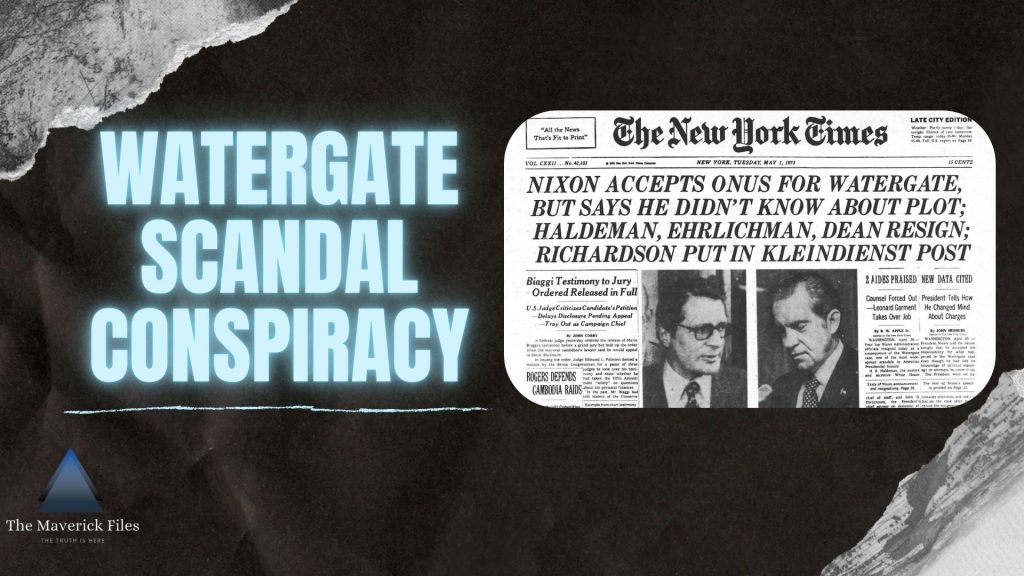
The Watergate scandal is often presented as a straightforward case of political espionage gone wrong, but for many researchers and conspiracy-minded historians, that explanation barely scratches the surface. Beneath the official narrative lies a far more complex and unsettling possibility, that Watergate was not merely a burglary and cover-up, but a glimpse into hidden power structures operating within the U.S. government during the Cold War. Officially, the scandal began with a break-in at the Democratic National Committee headquarters in June 1972 and ended with the resignation of President Richard Nixon in August 1974. Yet the simplicity of that narrative has long been questioned, especially when considering the backgrounds of the individuals involved and the broader geopolitical context.
The break-in itself occurred in the early hours of June 17th, 1972, when five men were arrested inside the Watergate complex in Washington, D.C. What initially appeared to be a routine burglary quickly unraveled into something much larger. The men were connected to Nixon’s reelection campaign, the Committee to Re-elect the President (CREEP), and were attempting to wiretap phones and photograph sensitive documents. As investigations deepened, it became clear that this was not an isolated incident, but part of a broader campaign of political espionage and sabotage targeting the Democratic Party.
The objective was to gather “dirt” on Democratic frontrunners and uncover their campaign strategies. The “official” theory is that the burglars wanted to bug the phone of DNC Chairman Larry O’Brien to monitor the Democratic strategy. They may have been searching for evidence that the Democrats were receiving illegal foreign contributions from players like Fidel Castro. Other theories dive into the possibility that some Democratic officials were mixed up in prostitution rings, a perfect blackmail strategy to gain capitulation. Nixon and the burglars had their expectations, but the mission was clear: obtain anything useful they could find as leverage.
Central to this operation were figures like E. Howard Hunt and G. Gordon Liddy, men with deep ties to intelligence agencies like the CIA and FBI, were involved in covert operations. The two men led the charge of five burglars to infiltrate the Watergate complex to wiretap phones and steal documents. James McCord was a security director for the Committee to Re-elect the President (CREEP) and a former CIA/FBI agent. Bernard Barker was a Cuban-American CIA contractor. Virgilio Gonzalez was a Cuban locksmith. Eugenio Martinez was a Cuban contact with the CIA. Lastly, Frank Sturgis was associated with intelligence operations. All five men were convicted on January 30th, 1973, of conspiracy, burglary, and wiretapping. They pled guilty and received sentences ranging from 1 to 40 years, with several serving roughly 14–16 months in prison, while McCord served 4 months. As for the organizers, both E. Howard Hunt and G. Gordon Liddy were also convicted and served prison time. Hunt was sentenced to 33 months, and Liddy served a longer sentence than any other Watergate conspirator, roughly 52 months, because he refused to cooperate with the prosecution. President Jimmy Carter commuted his 20-year sentence in 1977.
E. Howard Hunt, in particular, stands out as a key figure linking Watergate to a much larger web of clandestine activity. He was a former CIA operative who had been involved in anti-Castro missions, psychological warfare, and covert Cold War operations. He was also allegedly connected to Operation 40, a shadowy network said to consist of operatives skilled in sabotage, assassination, and regime destabilization. Richard Nixon, ironically, played a significant role in organizing and overseeing Operation 40 while serving as Vice President in the Dwight D. Eisenhower administration. For many, Hunt’s presence alone raises the question, why were individuals with such deep intelligence backgrounds involved in what was supposedly a political break-in? What else were they looking for? Is it because they had ties to intelligence that it would lessen the risk of exposure if caught?
This is where the narrative begins to intersect with one of the most controversial events in American history, the assassination of John F. Kennedy in 1963. Some theorists argue that figures connected to Operation 40, including Hunt, were present in Dallas in 1963. While the Warren Commission concluded that Lee Harvey Oswald acted alone, critics have long pointed to inconsistencies, missing evidence, and intelligence connections suggesting a broader conspiracy. Hunt himself was later accused of having been involved in the assassination.
Before his death in 2007, Hunt detailed a conspiracy involving the CIA and Lyndon B. Johnson in the assassination of John F. Kennedy in a “deathbed confession. Through recordings and notes made to his son, Saint John, Hunt alleged a plot involving CIA operatives Cord Meyer, Bill Harvey, and David Morales, along with a “French gunman” on the grassy knoll. Hunt claimed the CIA was heavily involved, specifically naming operatives David Atlee Phillips, Cord Meyer Jr., William Harvey, and David Morales as key conspirators.
Hunt also alleged that Vice President Lyndon B. Johnson (LBJ) was involved in the conspiracy to remove Kennedy from office. The “French gunman” (frequently identified in theories as Corsican Mafia member Lucien Sarti) was the shooter on the grassy knoll. None of this has ever been officially verified, of course. Strong critics suggest the information was gained through opportunistic hearsay, noting that Hunt was not considered a high-level “rainmaker” within the CIA and had a history of making unsubstantiated claims. I mean, how would these outsider skeptics know he’s lying or not is the bigger question. Seems like they’re just choosing not to believe him and immediately turn a blind eye to everything he said prior to his death pertaining to JFK.
From this perspective, Watergate begins to look less like a failed burglary and more like a containment operation. Some theories suggest that Nixon may have known or suspected sensitive information related to the Kennedy assassination, attributing it to Operation 40, which again Nixon oversaw during the Eisenhower administration. In this view, the break-in at the Watergate complex may not have been about political spying at all, but rather an attempt to retrieve or suppress documents tied to covert operations dating back to the early 1960s. It would explain why Nixon was forced to resign afterwards, for snooping around and sticking his nose where it didn’t belong.
Nixon’s own recorded words add fuel to this theory. The secret White House taping system captured conversations in which he discussed using the CIA to block the FBI investigation. In one particularly cryptic moment, Nixon referred to “the whole Bay of Pigs thing.” While this phrase is often taken at face value, some researchers interpret it as coded language referring to the Kennedy assassination, a sensitive subject tied to CIA operations and Cuban exile networks. Nixon also repeatedly requested CIA files on the JFK assassination during his presidency, particularly around the time of the Watergate scandal. Nixon, believing that the CIA was involved in Kennedy’s death and looking for leverage, sought this information for a variety of political and strategic reasons. His requests were consistently denied by then CIA Director Richard Helms. Gee, I wonder why.
Nixon’s goals were to exploit the alleged information to connect the CIA’s anti-Castro activities to JFK’s death, both to understand what happened and to potentially damage the credibility of the Democratic Party and his rival, Senator Ted Kennedy. As the Watergate investigation escalated, Nixon suggested that he could expose the CIA’s secrets regarding the JFK assassination if the CIA didn’t play ball and thwart the FBI investigation into the Watergate break-in.
As the scandal unfolded publicly, investigative journalists Bob Woodward and Carl Bernstein began uncovering a pattern of deception and obstruction. Senate hearings, conducted by the United States Senate Watergate Committee, revealed testimony from key insiders, including White House counsel John Dean, who stated that Nixon had been involved in the cover-up. Behind the scenes, a secret informant known as “Deep Throat,” later identified as Mark Felt, helped connect the dots between the burglars and the highest levels of government.
The crisis intensified dramatically in October 1973 during the “Saturday Night Massacre,” when Nixon ordered the firing of special prosecutor Archibald Cox after he demanded access to the White House tapes. Top Justice Department officials resigned rather than carry out the order, triggering a constitutional crisis and intensifying public outrage. Eventually, the case reached the Supreme Court of the United States, which unanimously ruled in United States v. Nixon that the president must release the tapes.
When the tapes were finally revealed in 1974, they contained the so-called “smoking gun”, a conversation from June 23rd, 1972, showing Nixon discussing the use of the CIA to obstruct the FBI’s investigation. This confirmed his direct involvement in the cover-up. Facing near-certain impeachment and removal from office, Nixon resigned on August 8th, 1974, the only sitting U.S. president to ever do so. He was succeeded by Gerald Ford, who later issued him a full pardon. Nixon barely got a slap on the wrist if you ask me. His political career may have been over, but he got to keep his freedom and, more importantly, his life. This was probably a warning from the CIA and upper echelon of government not to keep poking the bear; bad things can happen.
Officially, Watergate is remembered as a scandal of political corruption and abuse of power. But in conspiracy circles, Nixon’s resignation is sometimes viewed as something more, a forced removal designed to silence him or prevent him from exposing “classified” information. In this interpretation, Nixon may have been caught between powerful factions, political opponents on one side and entrenched intelligence networks on the other.
In the aftermath, numerous officials were convicted and imprisoned, and sweeping reforms were introduced to increase transparency and accountability. Yet the deeper questions have never fully disappeared. The overlap between intelligence operatives, covert Cold War programs, a presidential assassination, and one of the most consequential political scandals in U.S. history continues to fuel speculation.
Ultimately, the Watergate scandal exists on two levels. On the surface, it is a well-documented case of political espionage, obstruction of justice, and constitutional crisis. But beneath that surface lies a more ambiguous and contested narrative, one shaped by missing records, overlapping personnel, and the opaque nature of intelligence operations. Whether Watergate was simply a scandal or a glimpse into something far deeper depends largely on how one interprets those gaps. And it is within those gaps that the conspiracy theories continue to live. I mean, it’s not hard to read between the lines and ascertain that something pretty fucking peculiar was going on behind the scenes, and it involved dark forces inhabiting the government, the same dark forces that exist today. Please share your thoughts in the comment section. Be well.