By Maverick
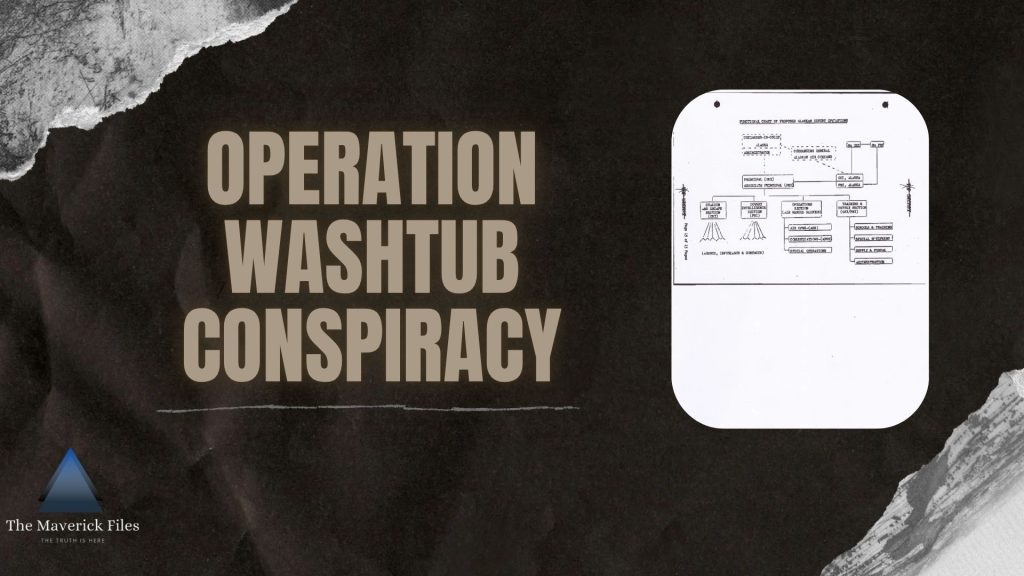
Operation Washtub is one of those Cold War stories that sounds like a conspiracy theory but is actually rooted in declassified government documents. While many people associate secret “stay-behind” networks with Europe and operations such as NATO’s anti-Soviet programs, few realize that the United States developed a similar contingency plan in Alaska during the height of Cold War fears. Declassified records reveal that from the early 1950s until Alaska achieved statehood in 1959, the FBI and the U.S. Air Force operated a highly secret program designed to prepare for what many policymakers considered a genuine possibility: a Soviet invasion and occupation of Alaska.
If someone were writing a Cold War thriller, they might invent a secret network of bush pilots, trappers, miners, and wilderness guides scattered across the Alaskan frontier, trained in espionage, covert communications, sabotage, and survival in preparation for a Soviet invasion. Yet that is essentially what Operation Washtub was.
For decades, the operation remained hidden from public view. Most Americans had never heard of it. Even many historians specializing in the Cold War were unaware of its existence. Only after the declassification of hundreds of documents did the scope of the program become publicly known.
The story begins in the early years of the Cold War. In Washington, policymakers viewed the Soviet Union not merely as a rival but as a potential military threat capable of launching attacks against North America. Alaska occupied a unique strategic position. Across the Bering Strait sat Soviet territory. The distance separating the two superpowers was far smaller than many Americans realized.
Military planners feared a scenario in which Soviet forces could invade Alaska through airborne assaults, paratrooper operations, or occupation of key infrastructure. Whether such an invasion was ever realistically likely remains debated among historians, but at the time, government officials took the possibility seriously. The result was Operation Washtub.
The operation was conceived as a “stay-behind” network. The concept was simple but chilling. If Soviet forces occupied Alaska, ordinary civilians already living throughout the territory would remain in place. These individuals would secretly gather intelligence, report troop movements, assist downed American personnel, maintain communication with friendly forces, and potentially support resistance activities against occupying troops.
Unlike traditional military personnel, these civilians acting as agents would blend naturally into the local population. They would already know the terrain, the weather, the transportation routes, and the communities. In many ways, they would become America’s insurance policy if Alaska ever fell behind enemy lines.
One of the most fascinating aspects of Operation Washtub was the type of people recruited. Government planners did not seek conventional spies. They wanted rugged Alaskans who could survive independently in some of the harshest environments.
Bush pilots were particularly attractive recruits. Their ability to travel across remote wilderness areas without attracting suspicion made them ideal candidates. Trappers, fishermen, miners, guides, and wilderness experts were also recruited. These were individuals whose daily lives already involved operating in isolated regions where movement would appear normal rather than suspicious.
According to declassified records, agents received specialized training in covert communications, coded messages, secret writing, intelligence collection, photography, recruitment techniques, survival skills, and resistance operations. They were expected to observe enemy activity and transmit valuable information back to American authorities if an occupation ever occurred. Some accounts suggest training included preparation for guerrilla-style resistance and sabotage operations.
The operation also involved the construction of hidden supply caches throughout Alaska. These concealed locations reportedly contained food, fuel, equipment, communications gear, weapons, survival supplies, and emergency resources. In theory, these caches would allow agents to continue operating even if conventional supply lines were destroyed or Soviet enemy forces controlled major population centers.
For conspiracy researchers, the existence of these hidden caches raises obvious questions. How many were actually built? Were all of them recovered? Did any remain undiscovered? Official accounts indicate that many were converted to survival caches or removed after the program ended, but speculation persists that not every location was successfully accounted for.
Another aspect that attracts scrutiny is the abrupt withdrawal of the FBI from the operation. Documents indicate that FBI Director J. Edgar Hoover unexpectedly ordered the Bureau to leave the project in 1951. Historians still debate the exact reasons. Official explanations suggest concerns about organizational embarrassment or operational complications should an invasion ever occur. They seemingly wanted to wash their hands of it. Yet because intelligence agencies rarely disclose every internal consideration, some researchers wonder whether additional motives existed behind the decision.
The CIA’s exact role has generated further speculation. While Operation Washtub is generally described as an FBI-Air Force project, various documents and later discussions have suggested that intelligence officials explored broader cooperation involving multiple agencies. The extent of CIA participation remains a topic of interest among researchers studying Cold War covert operations.
What makes Operation Washtub especially intriguing is its connection to the broader history of stay-behind networks around the world. During the Cold War, Western governments developed contingency plans across Europe to resist possible Soviet occupation. Some of these programs later became highly controversial after allegations emerged involving covert political activities, intelligence manipulation, and secret operations. As a result, some researchers view Operation Washtub as America’s Alaskan version of the larger stay-behind phenomenon.
One of the more controversial elements revealed by declassified documents concerns recruitment decisions. Records indicate that Alaska Native populations were often excluded from recruitment based on assumptions and prejudices held by intelligence planners of the era. These documents reflect attitudes that today would be widely regarded as discriminatory. For many historians, this aspect of the program offers insight into the mindset of Cold War intelligence agencies and the social assumptions that shaped their decision-making.
Perhaps the most remarkable fact about Operation Washtub is how completely it disappeared from public awareness. For decades, many of the individuals involved never spoke publicly about their participation. Some family members reportedly learned of relatives’ involvement only after the documents were declassified. The secrecy was so effective that an entire resistance network existed largely outside public knowledge for more than half a century.
This naturally fuels conspiracy theories. If the government successfully concealed an organized stay-behind network in Alaska for decades, what other Cold War contingency programs remain hidden? Were similar networks created elsewhere? Did any continue beyond their officially stated termination dates? Were all the records truly released? What else are they concealing from the general public?
There is currently no public evidence supporting claims that Operation Washtub evolved into a modern clandestine network or continued beyond its official closure. Nevertheless, the operation serves as a reminder that governments often prepare for scenarios the public never hears about until decades later, upon the declassification of secret documents.
The most important lesson of Operation Washtub may not be that a secret network existed. It is that the network existed because American officials genuinely believed that a Soviet invasion of Alaska was possible. The operation reflects the mindset of an era defined by nuclear fears, espionage, ideological conflict, and worst-case planning.
Today, Operation Washtub occupies a strange place between history and conspiracy. Much of what once sounded unbelievable has been confirmed through declassified records. Yet the existence of those records also encourages people to ask what remains undisclosed, whether within this case or other controversial topics. As with many Cold War intelligence stories, the known facts are fascinating enough on their own, while the unanswered questions continue to fuel speculation decades after the operation ended.
One interesting wrinkle: there were actually two different operations called “Washtub.” The Alaska stay-behind program is covered in this blog, but there was also a separate CIA operation in Central America connected to the 1954 Guatemala crisis that involved planting evidence to suggest Soviet influence. Could the two Operation Washtubs have had a bit overlapping by the CIA? Please share your thoughts in the comment section. Be well.