By Maverick
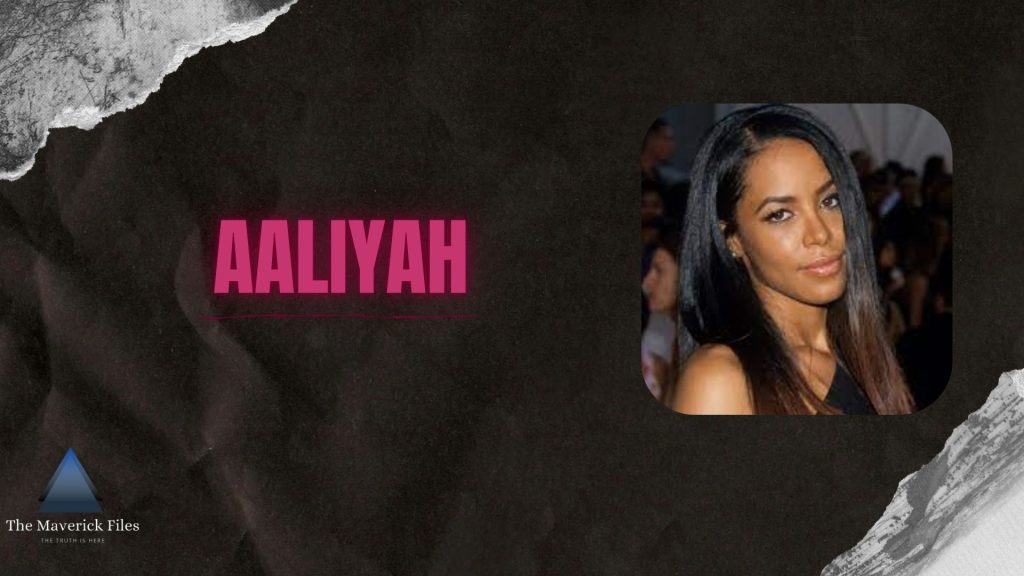
Aaliyah Dana Haughton was born on January 16th, 1979, in New York City and was raised primarily in Detroit, Michigan. She was known to many as the “Princess of R&B” and later the “Queen of Urban Pop.” Aaliyah became one of the most influential artists of her generation despite her life being cut short at just 22 years old. From a very young age, she displayed extraordinary talent. Her mother, Diane Haughton, recognized her musical abilities early and enrolled her in vocal lessons. Aaliyah’s family had strong connections in entertainment through her uncle, music executive Barry Hankerson, who had previously been married to legendary singer Gladys Knight. Through these connections, Aaliyah was exposed to the music business long before she became famous.
At just 10 years old, Aaliyah appeared on the television talent competition Star Search, performing “My Funny Valentine.” Although she did not win the competition, the appearance introduced her to a national audience and demonstrated her confidence as a young performer. Soon afterward, she began performing alongside Gladys Knight during a series of shows in Las Vegas. The experience gave her firsthand exposure to professional touring and helped convince industry insiders that she was destined for stardom.
Aaliyah’s uncle, Barry Hankerson, a prominent music executive and manager, founded Blackground Records in 1993, leveraging a crucial early distribution and joint venture production deal with Jive Records to launch Aaliyah’s career. Hankerson struggled to secure a major-label deal for Aaliyah, so he used his existing management relationship with another well-known artist, R. Kelly, to secure a contract. Kelly wrote and produced Aaliyah’s highly successful 1994 debut album, Age Ain’t Nothing but a Number.
The two met in 1992, and R. Kelly quickly became the mentor and producer for Aaliyah, who was just a child when he was 25 at the time. On August 31st, 1994, when he was 26, and she was 15, they secretly married in a Chicago hotel. Aaliyah was able to make it happen because she had a fake ID stipulating that she was 18, when she wasn’t. The marriage was annulled months later when Aaliyah’s parents discovered it. Following this, Aaliyah parted ways with R. Kelly and Jive Records. Pretty messed up, right? Now look where R. Kelly is today.
Throughout the rest of the 1990s, Aaliyah’s music career continued to elevate with her albums One in a Million and her self-titled final album Aaliyah. She worked with producers and artists such as Timbaland and Missy Elliott. She helped pioneer a futuristic blend of R&B, hip-hop, and electronic sounds that influenced countless artists who followed. By 2001, she was no longer just a singer; she was becoming a major Hollywood star.
Her acting breakthrough came in the 2000 action film Romeo Must Die, where she starred opposite martial artist Jet Li. The movie was a commercial success and proved that Aaliyah could transition from music to film, similar to Tupac Shakur or Janet Jackson. Her hit song “Try Again” from the Romeo Must Die soundtrack became a historic success, making her the first artist to top the Billboard Hot 100 based solely on radio airplay. Hollywood quickly took notice, and several major projects followed.
By the summer of 2001, Aaliyah’s film career was poised to reach another level. She had completed filming for Queen of the Damned, in which she played the powerful vampire queen Akasha, and had been cast in both The Matrix Reloaded and The Matrix Revolutions. She was originally hired to play the character Zee and had already begun filming scenes before her death. Following her untimely death, the role was recast with Nona Gaye. Many fans and industry observers have long believed that Aaliyah was on the verge of becoming a major Hollywood actress, with the Matrix franchise potentially serving as her gateway into blockbuster cinema, sort of like a Will Smith-type success.
Here is where things took a turn for the worse. On August 25th, 2001, Aaliyah died tragically in a plane crash in the Bahamas after wrapping up filming for her upcoming music video to the 2001 song “Rock The Boat.” She was just 22 years old. The timing of her death has fueled speculation for decades. Aaliyah died only 17 days before the September 11th, 2001 attacks, one of the most world-changing events in modern history. While there is no tangible evidence connecting the two events, conspiracy theorists have long pointed to the proximity of the dates as one of many strange coincidences surrounding her death. Her death was like the end of the calm before the storm, if you catch my drift.
As I mentioned above, Aaliyah had traveled to the Abaco Islands in the Bahamas to film the music video for “Rock the Boat,” which would become the final video of her career. Filming wrapped ahead of schedule, and rather than stay another night as originally planned, Aaliyah and members of her entourage decided to fly back from Marsh Harbour to Florida immediately. That decision would prove fatal.
The plane that arrived to take them home was a twin-engine Cessna 402B operated by Blackhawk International Airways, an aircraft charter, rental, and leasing company based in Florida. It was founded in 1991 by Gilbert and Erik Chacón. The airline ceased operations following Aaliyah’s death in 2001. Sometime between 1998 and 2001, Blackhawk was fined by the FAA four times for violating safety standards and failing to comply with maintenance standards. The company wasn’t keen on testing its employees for illegal drug use as well.
Luis Morales III was the pilot of the doomed flight. He had a falsified aviation record, a recent criminal record for drug possession, and was under the influence of cocaine and alcohol at the time of the crash. Definitely someone you would not want flying your plane. The National Transportation Safety Board (NTSB) and the Federal Aviation Administration (FAA) investigations revealed that Morales had falsely obtained his FAA commercial pilot license. He had falsified his logbooks, claiming hundreds of flight hours that he had never actually flown, making him unqualified and not approved to fly the plane.
It gets better, folks, if you’re not already familiar with the story. On August 13th 2001, Morales had pleaded no contest to four felony counts in a Florida court. These charges included possession of crack cocaine, grand theft, dealing in stolen property, and driving with a suspended license. The judge who presided over the case placed Morales on three years of probation and withheld a formal finding of guilt, which is nuts. Since he wasn’t technically “convicted” yet, the FAA was completely unaware of the charges, allowing him to keep his pilot’s license active. Morales also requested a special condition, ensuring that his probation officers would not contact his employer. A toxicology report and coroner’s inquest confirmed that Morales had traces of cocaine and alcohol in his system when the plane took off.
Things get weirder than that. Hype Williams was the director for the “Rock the Boat” music video. As I mentioned earlier, filming wrapped up a day early. Aaliyah and her crew were eager to return to the U.S. It is unknown exactly who chartered the smaller plane with Blackhawk, but it is a known fact that Aaliyah’s crew had a larger, 15-passenger turboprop plane scheduled to fly them back the following morning. Years later, Aaliyah’s then-boyfriend, Damon Dash, even publicly stated that a larger jet had been offered to Aaliyah, allegedly by singer Lenny Kravitz. Dash claimed that director Hype Williams used the larger jet for him and his crew instead. Conspiracy theorists tend to believe that it was done on purpose. More on that later.
Just before takeoff, witnesses near the runway reported that singer Aaliyah and her crew engaged in a heated argument with pilot Luis Morales III before boarding the flight. Morales and airport staff warned the group that their heavy video equipment and luggage made the Cessna 402 overloaded. The plane ultimately took off substantially overloaded by over 700 to 900 pounds and was carrying one more passenger than it was certified to hold. The plane’s engines immediately stalled, causing a nosedive, and crashed roughly 200 feet past the runway, killing all nine people onboard, Aaliyah included. The impact caused much of the plane to disintegrate.
Aaliyah’s body was found still buckled into her seat, roughly 20 feet away from the main wreckage of the plane crash. The island’s coroner reported that Aaliyah died instantly from a severe blow to the head and extensive burns. The medical report noted that she also went into such an extreme state of shock that survival or recovery would have been impossible even if she had initially survived the impact. She was buried and entombed on August 31st, 2001, at Ferncliff Cemetery and Mausoleum in Hartsdale, New York.
Official investigations concluded that overloading, improper weight distribution, and pilot-related issues were primary factors in the crash. No government investigation found evidence of foul play. However, the questions never stopped. Many fans believed there was more to the story than simple negligence. One of the most discussed revelations emerged years later from witness accounts that resurfaced around the twentieth anniversary of Aaliyah’s death. According to a Bahamian witness who claimed to have interacted with Aaliyah shortly before the flight, the singer allegedly did not want to board the small aircraft after seeing it. The witness claimed she complained of a headache, took a sleeping pill, and fell asleep. According to his account, she was later carried onto the plane while still asleep. These allegations were reported decades after the crash and have never been independently verified by investigators, but they immediately reignited speculation among fans. If true, some asked whether Aaliyah was physically incapable of objecting to boarding the aircraft she reportedly feared. Others wondered who made the decision to proceed despite concerns about the plane’s size and safety. The claims remain controversial and unproven, but they have become a central component of modern conspiracy theories surrounding her death.
Adding to the mystery were statements made by Damon Dash, where he has repeatedly said that if he had been present in the Bahamas, Aaliyah never would have boarded that plane. He has stated in interviews that there was “no chance” they would have gotten on the aircraft had he been there. Dash’s comments have fueled theories that members of Aaliyah’s team may have had reservations about the flight but chose to proceed anyway. Although Dash has never publicly claimed that Aaliyah was murdered, his persistent suggestion that the tragedy could have been prevented has kept public attention focused on unanswered questions surrounding the final hours of her life.
Another source of speculation involves Aaliyah’s uncle and manager, Barry Hankerson. Hankerson was not only a family member but also a powerful figure in her career as the founder of Blackground Records. Following the crash, lawsuits were filed against various parties connected to the flight. Over the years, reports circulated claiming that wrongful death litigation connected to the crash resulted in settlements worth tens of millions of dollars. Some conspiracy theorists have pointed to these settlements as a motive for foul play. However, no evidence has ever emerged linking Hankerson or any member of Aaliyah’s family to criminal wrongdoing. The existence of large settlements alone does not prove a conspiracy, though critics continue to question who benefited financially after her death.
Theories surrounding Aaliyah’s death often intersect with broader discussions about the music industry. Some theorists suggest she knew damaging information about powerful figures. There are also Internet rumors that hip hop mogul and billionaire Jay-Z once pursued Aaliyah romantically, and she wasn’t interested. It’s been speculated that Jay-Z is part of the secret society known as the Illuminati and replaced/sacrificed Aaliyah with his now wife, mega R&B star Beyoncé Knowles. Beyoncé’s career started out with her group Destiny’s Child, but quickly branched out and became solo, especially after Aaliyah was removed from the equation. Coincidence? Maybe. It’s similar to how Jennifer Lopez, aka J Lo, became a bigger star once Tejano singer Selena was killed in 1995, leading to J Lo playing her in a biopic, which launched her music career into stardom.
There are also theories involving symbolism and timing. Conspiracy-minded researchers note that Aaliyah was on the verge of superstardom beyond music. She had starred in films, released a critically acclaimed self-titled album only weeks before her death, and appeared positioned to become one of the dominant entertainers of the next decade. Some theorists argue that her sudden death resembles other celebrity tragedies in which rising stars died at pivotal moments in their careers, hence concluding that she was sacrificed by the invisible hand that is the Illuminati. These theories often point to a pattern rather than direct evidence, which is enough to convince certain people, and there definitely is a pattern, based on all the other celebrities I’ve written about, I can concur to that.
Almost 25 years later, the official explanation remains unchanged: an overloaded aircraft, an unqualified pilot, and catastrophic operational failures led to the crash. Yet for many fans, the unanswered questions continue to linger. Why was an overloaded plane allowed to take off? Why was a pilot with documented issues operating the flight? Did Aaliyah object to boarding? Was she really asleep when she was carried onto the plane? Could the tragedy have been prevented by a single decision to wait until the next day? It’s highly peculiar and suspicious for an event that was beyond easy to prevent to have played out the way it did.
For nearly 20 years, Aaliyah’s music was kept unavailable on digital streaming platforms like Spotify or Apple Music. Barry Hankerson intentionally pulled her music from the market in 2012, citing concerns over how the emerging streaming model treated independent labels. Aaliyah’s fans and the estate, managed by her mother Diane Haughton and brother Rashad Haughton, criticized this move. In August 2021, Hankerson reached a distribution deal with independent music company EMPIRE to finally bring Aaliyah’s Blackground Records catalog to streaming platforms. While fans celebrated the long-awaited availability of her music, Aaliyah’s estate publicly opposed the move. They released statements criticizing the deal as an “unscrupulous endeavor” conducted without transparency or full accounting to the estate, creating an ongoing tension between Hankerson’s business decisions and the family’s wishes for her legacy.
Looking back, what makes Aaliyah’s story so compelling is how much she accomplished before turning 23. She had already become a multiplatinum recording artist, award-winning performer, successful actress, fashion icon, and businesswoman. At the time of her death in August 2001, she was arguably entering the most promising phase of her career, with a chart-topping album, major film roles, and growing influence across both music and Hollywood. Her legacy continues to endure more than two decades later because many believe the world only saw the beginning of what she could have become. Please share your thoughts in the comment section. Be well.