By Maverick
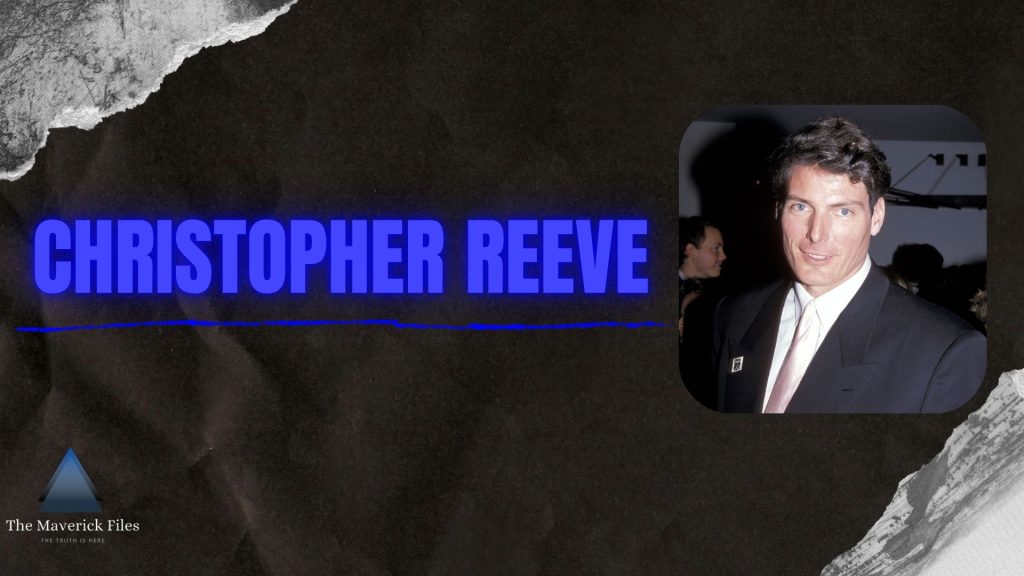
Few stories in Hollywood are as inspiring, tragic, and mysterious as that of the legendary Christopher Reeve. To millions around the world, Reeve was Superman, the embodiment of strength, courage, and invincibility. Yet his real-life journey would ultimately prove even more remarkable than the fictional hero he portrayed on screen. His life became a story of triumph, devastating tragedy, relentless perseverance, medical advocacy, and, for some, lingering questions about the circumstances surrounding the accident that changed everything. I know that I already did a compilation on Chris, but I also felt I could explain more in depth by writing a blog about his story and diving into the controversy surrounding the untimely accident that rendered him paralyzed until he passed away in 2004.
Born on September 25th, 1952, in New York City, Christopher D’Olier Reeve developed a passion for acting at a young age. He attended Cornell University and later studied at the prestigious Juilliard School alongside fellow actor Robin Williams. The two were roommates and became incredibly close over the years. Throughout the 1970s, Reeve worked steadily in theater and television, earning a reputation as a talented and disciplined performer. However, nothing could have prepared him for the role that would define his career.
In 1978, Reeve was cast as Superman in Superman. Standing at 6 feet 4 inches tall and possessing a naturally athletic build, he transformed himself physically for the role. -The film became a global sensation, and Reeve instantly became one of the most recognizable faces on Earth. He reprised the role in multiple sequels and became forever associated with the image of a man who could fly. For an entire generation, Christopher Reeve was Superman. I could attest to that. There will never be another one like him.
Yet despite his fame, Reeve was determined not to be defined solely by one role and leaned into a more versatile approach. Throughout the 1980s and early 1990s, he appeared in numerous films, stage productions, and television projects. He was also known for his intelligence, activism, and adventurous spirit. One of the passions he developed later in life was horseback riding.
Interestingly, Reeve did not grow up as a lifelong equestrian. He became deeply interested in horseback riding during the 1980s while preparing for film roles that required riding skills. What began as professional training evolved into a genuine passion. He embraced competitive riding and eventually became involved in eventing, a demanding equestrian sport that combines dressage, cross-country jumping, and stadium jumping. Like many enthusiasts, Reeve viewed horseback riding as a challenge that required discipline, trust, and partnership between horse and rider.
As we know, that passion would lead to the day that changed his life forever.
On May 27th, 1995, Christopher Reeve was competing in an equestrian event at the Commonwealth Dressage and Combined Training Association competition in Culpeper, Virginia. He was riding a 12-year-old Thoroughbred-cross horse, Eastern Express, aka Buck, which he had since filming the movie “Village Of The Damned” in 1994. According to official accounts from that day, Reeve approached a relatively modest jump measuring approximately 3 feet 3 inches high. Compared to many obstacles encountered in competitive eventing, this was not considered an exceptionally difficult jump, and Chris practiced with Buck countless times.
As Buck approached the obstacle, something unexpected happened. Witnesses reported that the horse suddenly stopped instead of clearing the jump. Reeve was thrown forward over the horse’s head. Because his feet remained caught in the stirrups momentarily, his body rotated violently. He landed headfirst, suffering catastrophic trauma to his cervical spine. Specifically, he fractured his first and second cervical vertebrae, commonly known as C1 and C2.
The injury was devastating. Reeve’s spinal cord was severely damaged, leaving him paralyzed from the neck down and unable to breathe independently. Emergency responders rushed him to the hospital, where surgeons worked to stabilize his condition. At one point, Reeve reportedly considered ending life-support treatment due to the severity of his injuries. However, after encouragement from his wife, Dana Reeve, he chose to continue living and fighting. She was his inspiration because she reminded him that he’s still him despite being injured. That’s what gave him the spark to persevere. Chris didn’t want to be a burden to his family, and Dana didn’t like feeling helpless. It was a drastic adjustment.
The contrast was almost impossible for the public to comprehend. The man who had once symbolized flight, power, and physical perfection was now confined to a wheelchair and dependent on a ventilator. Newspapers around the world highlighted the heartbreaking irony. The actor who portrayed Superman, a hero capable of surviving almost any injury, had suffered one of the most severe spinal cord injuries imaginable. Chris’s courage and relentlessness proved just how similar he and Superman really were.
Rather than retreat from public life, Reeve embarked on a new mission. He became one of the world’s most visible advocates for spinal cord injury research. He founded and supported organizations dedicated to finding treatments and cures for paralysis. Through the Christopher Reeve Foundation, later renamed the Christopher & Dana Reeve Foundation, he raised millions of dollars and brought unprecedented public attention to spinal cord injuries.
Reeve became particularly interested in stem cell research. During the late 1990s and early 2000s, stem cells represented one of the most promising frontiers in regenerative medicine. Scientists believed that stem cells might someday help repair damaged spinal cords, regenerate nerve tissue, and restore function to paralyzed individuals. Reeve passionately argued that governments should support scientific research into these technologies. He testified before lawmakers, gave speeches, and challenged political leaders to accelerate medical progress.
At a time when stem cell research was politically controversial in the United States, Reeve emerged as one of its most prominent advocates. He argued that scientific advancement offered real hope to millions of people living with paralysis and neurological diseases. Although a cure remained elusive during his lifetime, many researchers credited him with dramatically increasing public awareness and funding for spinal cord research.
Before I forget to mention it, in a remarkable twist of fate, Reeve also portrayed a paralyzed police officer in the 1995 television film Above Suspicion. The project was filmed before his accident and was released, like, literally a week before he became paralyzed for real. Viewers were stunned to watch Reeve portray a character living with paralysis just months after suffering his own catastrophic spinal injury. What had originally been a dramatic role suddenly appeared almost prophetic. Was it a coincidence? Or was it the Powers That Be in Hollyweird pulling some kind of sick stunt that they always seem to do in some form of predictive programming, showing us something before it happens by cleverly hiding it in plain sight, using media to present it?
Throughout the final years of his life, Reeve continued to work, direct films, write books, and advocate for medical research. He even experienced small improvements in sensation and movement through intensive therapy programs. Although he remained quadriplegic, he became a symbol of determination and resilience.
On October 10th, 2004, Christopher Reeve died at the age of 52. The immediate cause was cardiac arrest following complications related to an infection. Years of living with severe paralysis had made him vulnerable to numerous health complications, unfortunately. His death was mourned worldwide. Just eighteen months later, his wife Dana would also pass away after a battle with lung cancer, leaving behind their son, Will.
Because of the extraordinary circumstances surrounding the accident, conspiracy theories eventually emerged. One of the most common focuses on the horse Buck’s sudden refusal at the jump. Supporters of this theory note that Buck reportedly had no significant history of refusing obstacles and argue that the jump itself was relatively modest at 3 feet 3 inches. They question why an experienced horse would abruptly stop at such a routine obstacle. There’s also the number 33 that pops into people’s heads, since 33 is the highest degree of Freemasonry, and it’s been speculated for a long time that the Freemasons and Illuminati control the entertainment industry.
Another theory centers on the unusual irony surrounding Reeve’s life. Some conspiracy-minded observers point to his portrayal of Superman and his later role in Above Suspicion, claiming the sequence of events seems too coincidental to be merely that. They suggest there may have been hidden factors surrounding the accident that were never publicly disclosed. Was the horse intentionally spooked? That could be a strong possibility.
A more extreme theory alleges that details about the accident were intentionally concealed or altered. Some proponents speculate about equipment failure, undisclosed medical issues, or inaccuracies in witness accounts. However, no credible evidence has ever emerged to support these claims.
Others have suggested paranormal or symbolic interpretations, pointing to the seeming contrast between a man famous for flying and an accident that resulted in paralysis. These theories generally rely on symbolism rather than evidence and are not taken seriously by investigators or historians, of course. It does make you wonder, though. It should also be known that Chris’s full name, Christopher D’Olier Reeve, equals the number 257 in ordinal gematria, and by switching the numbers around, you get 527, May 27th, the day of his supposed accident. I’m not saying that this cracks the case wide open, but it helps to have all the facts, whether it’s tangible or symbolic.
The documented facts remain straightforward. Multiple witnesses observed Buck refuse the jump. Reeve was thrown headfirst, suffered catastrophic cervical fractures, and sustained a severe spinal cord injury. Investigations found no evidence of foul play, sabotage, or criminal conduct. Equestrian experts note that even highly trained horses can unexpectedly refuse jumps, and such incidents, while uncommon, are a recognized risk within the sport. However, it’s not like it was a high jump, though. It’s not like Buck could tell us why he got spooked in the first place, but my spidey senses tell me that something doesn’t sit right with this one.
Chris doesn’t even have any account of the accident either. A traumatic injury can do that. He was wearing a helmet and protective riding gear as well. He also had to put the pieces together by talking to folks who were there to understand why this happened. He was trained to handle the horse, practiced 6 days a week, and knew how to fall if something happened. In the end, he said it was a total freak accident for a jump that small since he believed he had prepared long and hard enough. Another interesting coinkydink is that the helicopter that brought Chris to the hospital was named Pegasus, or “flying horse” in Greek mythology.
In the end, Christopher Reeve’s legacy extends far beyond conspiracy theories or even his portrayal of Superman. His greatest achievement may have come after his accident. Faced with circumstances that would have broken many people, he chose to fight, not only for himself but for millions of others living with paralysis. He transformed personal tragedy into a global movement for scientific research, rehabilitation, and hope. He was a quintessential real-life hero.
The image of Christopher Reeve soaring through the sky as Superman remains iconic. Yet perhaps the more powerful image is the one that came later: a man in a wheelchair refusing to surrender, determined to help future generations walk again. While his body was confined, his influence was not. In many ways, Christopher Reeve’s most heroic act was not playing Superman; it was showing the world what real courage looks like after the cape comes off, when you’re at your most vulnerable and still find the strength to fight the odds. Please share your thoughts in the comment section. Be well.